INIU P41L Power Bank: Small, Light, But Not Without Issues

About a month ago, a small Amazon parcel arrived at my door with a non-descript box inside. This held the INIU P41L 10,000mAh power bank, and despite the name looking like something created by a cat walking over the keyboard, I was glad to see it show up.
I bought the P41L with a specific goal in mind: keeping my phone charged on a long hike that I’m starting next month. I’ll be walking around 1000km (630 miles) over the course of 6-7 weeks, carrying everything I need and camping most nights.
Although the trail goes through towns and villages most days, I often won’t have access to power where I’m camping. That means I needed a power bank that can charge itself as fast as possible, as I’ll mostly be limited to plugging in while having a drink or meal somewhere.
I also wanted something with at least two ports, ideally with one of them being an old-school USB-A for my equally old-school Fitbit charger so I don’t have to carry a little adapter.
Other things on the wish list included an integrated cable (one less thing to lose) and pass-through charging. The latter means if I’ve only got one socket available, I can plug my phone into my power bank, my power bank into the wall, and charge both at the same time.
I’ve got a bunch of other power banks lying around from the companies like Anker and UGreen that I usually use for travel, but they all weigh more than I want to carry and don’t charge fast enough.
Poking around on various ultralight backpacking forums, I came across two main sets of recommendations: Nightcore and INIU. Neither of them are mainstream power bank brands, and only one of them fit my budget, so that made for an easier decision.
INIU had a few different models to choose from, but this was the one that, on paper at least, seemed the obvious choice.
I’m on the road for a while before the hike, so am writing up this review after a week where I’ve used it like most travelers will: afternoon top-ups after draining my battery exploring the city, and after long-haul flights on budget airlines where outlets of any sort have been left off the fitout list.
Once I’m finished the walk in October, I’ll post an update with my thoughts on how it performed, and whether I’d recommend it for long-distance hikers looking for a lightweight charging option.
Features and Specifications

I’ve lost track of the number of times I’ve used variations on the phrase “boring black box” to describe a piece of tech gear, but for once, that’s not entirely true here.
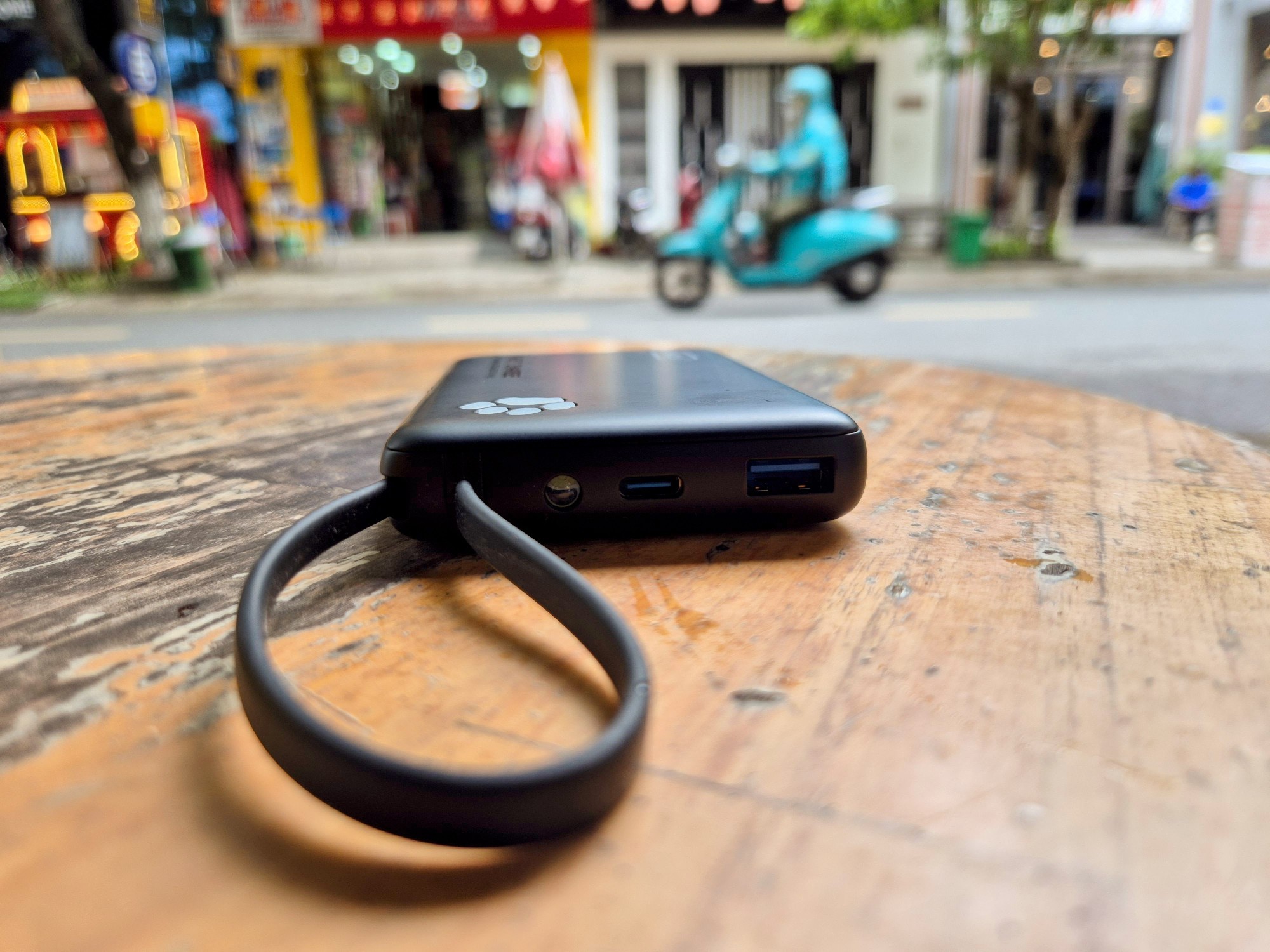
I mean yes, it’s black, and yes, it’s generally boring, but the large LED pawprint in one corner certainly makes this power bank stand out. Whether it stands out in a good way, well, that’s a little more debatable, but stand out it definitely does.
That pawprint isn’t entirely decorative, though: each segment serves as a capacity indicator. If the whole paw is illuminated, you’re at 100%. One flashing light and it’s about to die.
INIU P41L Specifications
|
Capacity: |
10,000mAH |
|
Ports: |
1x USB C, 1x USB-A, 1x integrated USB C cable |
|
Dimensions: |
11 x 7 x 1.8cm (4.3 x 2.7 x 0.7 inches) |
|
Weight: |
Officially 179g (6.3oz), measured at 191g (6.7oz) |
|
Max Input Charging: |
27W |
|
Max Output Charging: |
45W USB C, 22.5W USB-A |
|
Pass-through Charging: |
Yes |
|
Other Features: |
Flashlight |
Other than that, the most obvious feature is the integrated USB C cable. The head of the cable fits into a notch on the side, as you’d expect. Because that notch is at the top, though, the cable itself forms a large loop that looks for all the world like a carry handle.
It is not, in fact, a carry handle.
Well, not unless you like the idea of it quickly working loose and hitting the ground half a second later. The upside of the cable design is that it puts less of a bend in it when stowed, but it also makes it snag on things and take up more room in your pocket. I’m not convinced it was the best approach.
Other than that, the rest of the design is pretty standard: power button on one side, ports and flashlight along the top edge. Usefully, the power output for each of those ports is printed on the back.
A quick tap on the power button lights up that paw to show how much battery life remains, while a double-tap turns the flashlight on and off. That’s really about it for features: this is a power bank, after all, not a jumbo jet.
INIU makes much of the diminutive nature of the P41L, saying it’s 25% smaller and 15% lighter than others of the same capacity. That’s the kind of vague claim that’s hard to disprove, but one thing that did stand out was the difference between the stated and actual weight.
On the Amazon listing and company website, the P41L is listed at 179g (6.3oz). I weighed it at 191g (6.7oz) on two different sets of scales, a difference of around 7%. Many people won’t care, but if you’re someone who cuts your toothbrush in half to save weight on long distance hikes, you probably will.
One thing I hadn’t been able to find in the instructions or marketing material was any real detail on the pass-through charging other than that it existed, or what to expect when charging two devices at once.
As my testing was to show, there’s probably a reason for those omissions.
Bench Tests

Before leaving home, I used a USB power meter to test the accuracy of INIU’s claims, along with a few other tests that I couldn’t find claims for but seemed relevant.
All of the tests were done from a 100W wall charger, with a 100W USB C cable and high-quality USB-A cable.
|
Feature |
Listed |
Measured |
|---|---|---|
|
USB C cable max output |
45W |
43.2W |
|
USB C port max output |
45W |
43.2W |
|
USB A port max output |
22.5W |
14.8W |
|
USB C max input |
27W |
25W |
|
Recharge from empty |
1.8 hours |
1.9 hours |
|
iPhone 16 Pro charge in 25 minutes* |
63% |
49% |
|
iPhone 16 Pro charges* |
2.0 |
2.1 |
|
Samsung Galaxy S24+ charge in 25 minutes |
– |
58% |
|
Samsung Galaxy S24+ charges |
– |
1.7 |
|
USB C + USB A output |
– |
11.9W and 5W |
|
USB C + USB C output |
– |
11W and 5W |
|
Pass-through charging (input) |
– |
8W |
|
Pass-through charging (output) |
– |
4W |
The asterisk beside the iPhone 16 results is because I was testing with the Pro version, not the standard model that INIU lists. There’s only a miniscule difference in battery size between the two but it’s not exactly the same phone.
As you can see, the results were a bit of a mixed bag. When it comes to the headline features like 45W charging, capacity, and self-recharge time, the marketing claims generally match the reality.
It wasn’t without issue, though. It didn’t always negotiate the top charging speed for my Galaxy S24+, sometimes requiring one or two unplug/replug attempts before the “Super fast charging” message popped up.
It seemingly also overheated once, or at least glitched in a way where the lights on the power bank flashed and went out and the phone stopped charging. The bank was warm but not hot to the touch. Unplugging/replugging got things moving again, but it’s not ideal if you don’t notice it happening.
Still, as long you’re only using one cable, whether that’s to charge a device or the power bank itself, it generally performs as expected. As soon as you throw a second cable into the mix, however, things go quickly downhill.
I’d have expected that 45W max output to get evenly split over the two USB C ports, for example, somewhere in the region of 20W each. The actual result (11W from one port, 5W from the other) was so low that I tried different phones and cables to make sure it wasn’t a problem with my testing setup.
Sadly, it wasn’t. Neither of those speeds are enough to fast-charge a phone; 5W is barely enough to charge one at all.
Trying to simultaneously charge from the USB-A port and a USB C cable, integrated or separate, was much the same. There’s no reason I shouldn’t be able to fast-charge a phone and trickle-charge my watch at the same time from a 45W power bank, but as soon as I plugged in the Fitbit, output to the phone dropped by two-thirds.
The biggest disappointment, however, was the pass-through charging. Like I mentioned, I’d really hoped to use this feature during my hike: it’d let me carry a smaller single-port charger and still charge my phone and power bank at the same time.
Is that technically possible? Sure, I guess…but given the input rate drops to 8W and the output to a measly 4W, it’s going to take all night (at least) to get them both back to 100% charge. That’s maybe fine when you’re staying in a hotel, not so much when you’re camping.
Guess I’m back to a two-port charger again.
Real-World Tests

My first chance to use the power bank in the real world came at about 4am in Kuala Lumpur, as I lay on the floor of the airport terminal desperately trying to get some sleep after an overnight flight.
Air Asia, like several other airlines these days, bans the use of power banks onboard, so I’d sat there watching my phone battery slowly drain throughout my eight-hour flight.
With another flight coming up in a few hours, I took the opportunity to juice up my phone as I dozed. The charging was more successful than the sleeping: I wasn’t feeling any more recharged when I got up an hour later, but my phone certainly was.
The same has applied throughout the last week as I’ve wandered around the city and spend afternoons lying on the beach. Even after several hours of taking photos and using maps, 20 minutes on the power bank has been more than enough to see me through to the end of the day.
The flashlight worked fine, the one time I used it to make sure I hadn’t left anything in the hotel safe before checking out. It’s not the brightest light you’ll ever use, but it does the job in a pinch.
When I found both my phone and the power bank sitting at under 20% charge late one evening, it felt like the perfect opportunity to test my theory about the pass-through charging being largely useless.
At around 9pm, I plugged the power bank into my wall charger, my phone into the power bank, and left it overnight to see what happened (after covering the brightly-flashing blue LED so it didn’t continue to blind me).
Sure enough, when I woke up ten hours later, the phone was charged, but the power bank was still somewhere around half-full. Given that it would have taken about three hours total to charge both devices if I’d plugged them in separately, that’s…not great.
Get regular updates from the world of travel tech and remote work
News, reviews, recommendations and more, from here and around the web
Verdict
So after all of that, how do I feel about the INIU P41L?
In many ways, I’m happy with it. Despite being heavier than advertised, it’s still lightweight for a 10,000mAh power bank, and its slim design means it fits easily into the pocket of a pair of shorts.
It charges itself quickly: under two hours from empty to full is faster than the other power banks I own of the same size. Likewise, with only one device connected it gets very close to the advertised 45W output, which makes for speedy phone charging and even the ability to top up my laptop.
The integrated USB C cable means one less thing to lose, and while I don’t love the loop design of it, it’s fine as long as I remember not to try and use it as a handle.
The flashlight is useful if you don’t have anything brighter to use, and the inclusion of both USB C and USB-A sockets means I can charge anything I’m likely to be traveling with without resorting to dongles and adapters.
As I’ve mentioned throughout this review, though, the problems arise as soon as I connect more than one device. Charging rates drop much more than they should, and pass-through is so slow that I’m struggling to see much of a use for it in the real world.
That’s disappointing, given I’d hoped to use that feature extensively on my upcoming walk. The relatively light weight means I’ll stick with the P41L and deal with carrying a larger wall charger, but I’m not thrilled about it.
I’ll update this review towards the end of the year once the walk is over, but for now, I’d say: this is a good little power bank if size, weight, and fast charging are important to you. Just don’t plug in more than one thing at once!
Buy on Amazon