UGreen’s 500W Desktop Charger Is Seriously Big and Seriously Powerful

Anyone with a home office and an excess of technology will already be well aware of how annoying it is to keep it all powered up. As soon as you have more than two or three devices, dealing with the power strips, chargers, and cables becomes a hassle, especially if you detest clutter as much as I do.
Enter the desktop charger. USB C versions of these have been around for a few years, with the goal of getting rid of the power strips and individual chargers, and moving the cables closer to the devices so they don’t get as tangled and messy.
They’ve done with this varying degrees of success: earlier versions were fine for smaller devices, but struggled to put out enough power to fast-charge several gadgets at once. Throw a laptop into the mix, and charging slowed to a crawl.
The first desktop charger I came across that actually did the job well was UGreen’s 300W Nexode model that I reviewed about 18 months ago. It wasn’t particularly small, light, or cheap, but it could fast-charge a couple of laptops at once and still have enough juice left over for a phone and tablet.
I thought that was about where chargers like these would top out, but not so much. UGreen released the updated 500W model a few days ago, and sent out a sample to get my thoughts on it. It’s bigger, heavier, and more expensive than the earlier version, but is it actually better?
The answer is yes…but not for everyone.
- Weight: 3.6 pounds (1618g)
- Dimensions: 5.8 x 4.6 x 2.4 inches
- Max Power Output: 500W
- Ports: 1x 240W USB C, 4x 100W USB C, 1x USB-A (20W)

Features and Design

The charger showed up in a solid, reinforced box, which is no surprise: as I’ll keep saying throughout this review, this is a heavy piece of equipment, and it needs a bit of protection in transit.
Inside, there’s not a lot to report: the charger itself, a couple of small instruction booklets, and a thick and usefully-long 6ft/2m power cable. What there isn’t, however, is a USB C cable. That’s surprising, given that the earlier model came with a high-spec cable to help make the most of the power on offer.
While people generally have more USB C cables lying around than they know what to do with, most of them won’t handle more than 60W or so. It would have been nice to see at least one high-end cable in the box, given the price you’re paying.
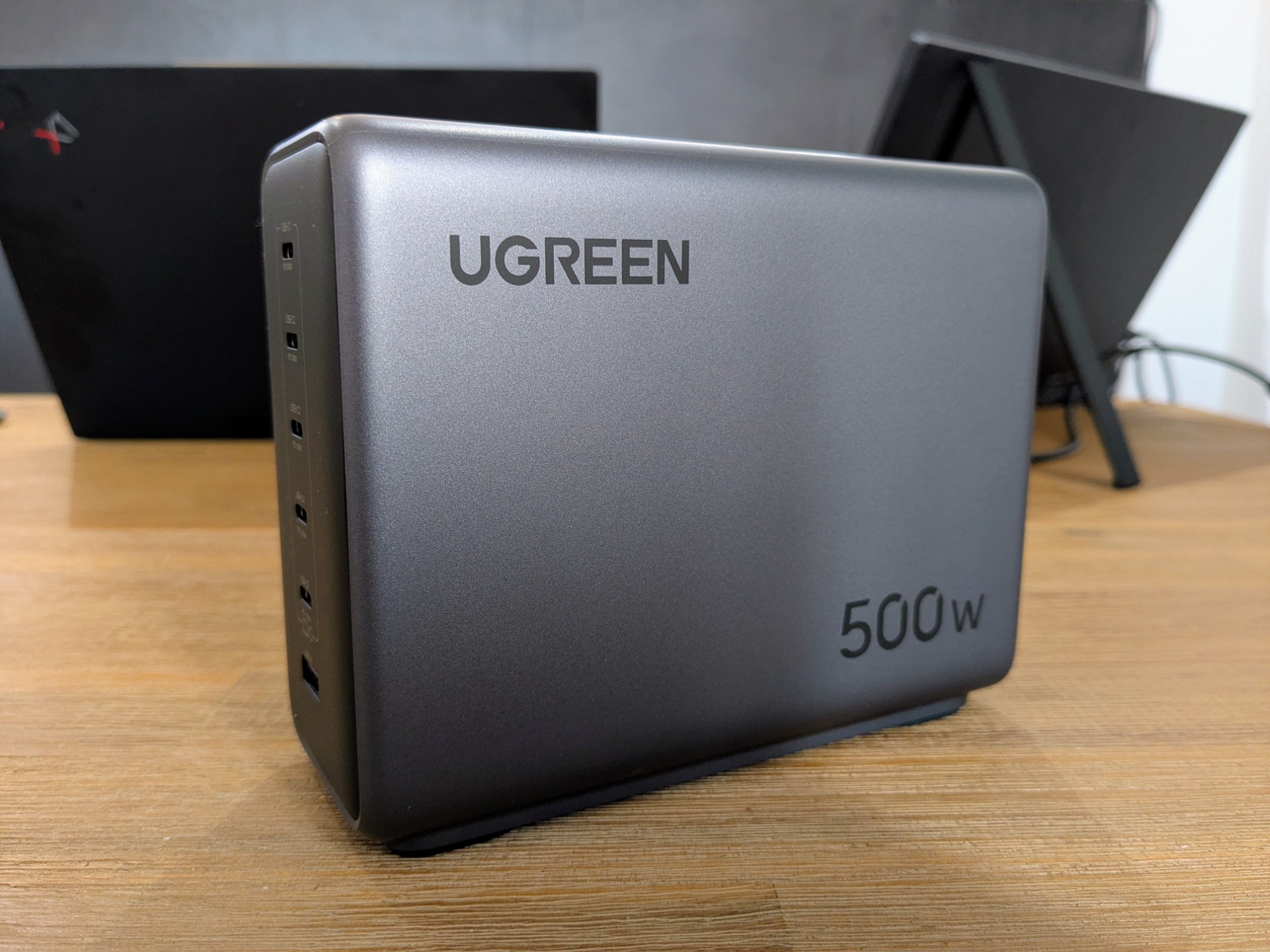
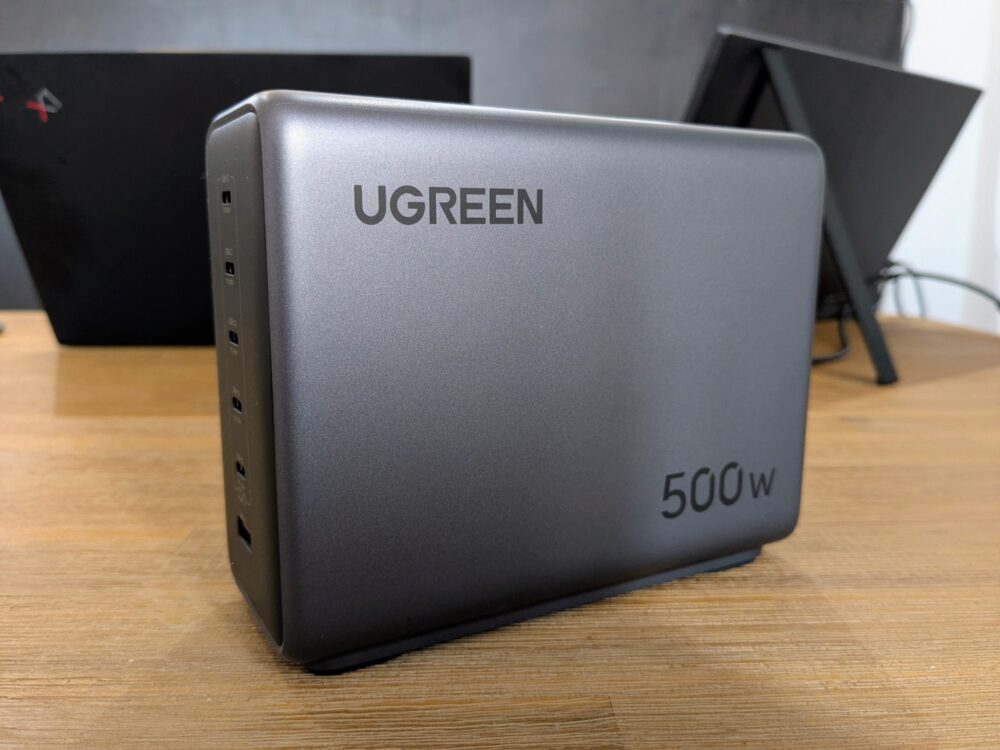
In terms of size and weight, the charger falls squarely into chonk territory. At 3lbs 9 ounces (1618g) and 5.8 inches (14.8cm) on its long edge, the “desktop” part of the name is very much accurate.
It weighs twice as much as its predecessor, a charger that I said at the time was already too heavy to travel with. Let’s just say that you won’t be dropping this in your carry-on anytime soon.
The charger looks serious and professional with its brushed grey and black design and reasonably subtle branding. The six ports on the front (five USB C, one USB-A) are laid out vertically, with all except the USB-A having their maximum output printed underneath.

500 watts is a hell of a lot of power to share around when it comes to anything that charges over USB, and it shows.
The top port is rated to put out up to a remarkable 240W, while the four below it can all handle up to 100W. The USB-A port tops out at 20W, which is still quite a bit for that old-school socket.
Some simple maths will tell you that 240 + (4×100) + 20 do not equal 500, but if you can manage to max out this charger, you’re doing better than me. Even with three laptops, a phone, a portable monitor, and a set of headphones all connected, I didn’t come close.
That 240W port at the top really is the “charge-everything” option: there are no USB C-powered devices out there today that need anything like that.
There are relatively few laptop models able to draw even half that amount, and none that I can think of that require it: even high-end gaming machines or the MacBook Pro 16 will just charge a bit slower than they’re capable of.
In reality, of course, you don’t buy a 500W charger that weighs more than your laptop just to charge said laptop. Nearly half of the instruction booklet is devoted to outlining every possible combination of ports and how much power you’ll get when using them.
I’m not going to go through all 58 different configurations here, but in summary: plug in three devices or less, and they’ll all get the maximum output from their ports. Plug in four, five, or six devices, and you’ll see some of the 100W USB C ports drop down to 60W. That’s literally it in terms of compromise.
The top port will still put out 240W, the bottom port will still put out 20W, and other than having a bigger mess of cables to deal with, you’re unlikely to notice the difference. Even 60W is enough to charge most smaller laptops at something very close to full speed, never mind phones, tablets, and whatever else you’re connecting.
Real-World Testing

So that’s all well and good as far as specifications go, but if 15 years of reviewing portable electronics has taught me anything, it’s that when spec sheets collide with the real world, disappointment often ensues.
I’ve had chargers that overheat and stop working entirely, or intermittently reset themselves, or simply don’t put out as much power as they say they will. That’s been especially true of multi-port chargers like this.
Based on my experience with the previous model, though, I had quite high hopes for this UGreen charger, and in the end I wasn’t disappointed.
That maximum 240W output is so high that I don’t actually have a way of testing it, but suffice to say that anything I plugged into the top socket charged as fast as physically possible.
Last year’s 14″ MacBook Pro model, for instance, happily pulled down nearly 90W with two phones charging from other ports at the same time.

Likewise my two Windows laptops, both with 65W max charging, got as close to that number as I’ve ever seen regardless of which of the USB C ports I used. Even when I plugged all three laptops in at once, the charging speed didn’t drop to any of them.
I spent a solid hour creating a rat’s nest of cables and gadgets on my desk, plugging and unplugging everything dozens of times in a near-endless set of combinations. As long as I was using a quality cable, everything capable of reporting a fast charge did so, no matter what else was connected.
Now and again, unplugging or connecting a laptop would cause the charger to reset itself: the portable monitor would blink off and back on, and charging icons would briefly disappear from the other devices.
That’s normal behaviour for chargers like these, especially when removing something from one port means the others now have more power available. That reset lets them renegotiate the power output with whatever’s on the other end, and if possible, charge it more quickly.
There’s a fair amount of thermal control built into this charger, which feels necessary given the power output. It seems to do the job: even after three hours of testing with several devices charging at once, the outer casing was barely warm to the touch.
It was the same during more normal use over the next several days. I had at least two devices plugged in all the time, and usually two or three others as well, and again there was no real heat coming off the charger.
Get regular updates from the world of travel tech and remote work
News, reviews, recommendations and more, from here and around the web
Verdict

When I reviewed the 300W model back in late 2023, I called it the one charger to rule them all. At the time it was, but 18+ months is a long time in tech. As long as you don’t mind the size of this new version, there’s now very much a new king in town.
In my testing the Nexode 500W lived up to its claims, reliably charging anything I connected and putting out as much power as the device could handle. It never got hot, or even particularly warm, and basically just worked as expected the entire time.
That said, it isn’t cheap by any stretch of the imagination, and if you only need to fast-charge one or two devices at once, it’s overkill. You can find chargers that will do that for a lot less money, including the 300W version that’s still on sale as I write this.
It’s also very big and heavy as far as chargers go, clearly the kind of gadget that’s really designed to stay in one place rather than forming part of a portable office setup.
The marketing material shows, among other things, a group of five office workers around a meeting-room table, earnestly discussing a dull-looking presentation with their laptops all plugged into this charger.
That’s the kind of scenario that it seems ideally suited to, turning a sprawling mess of laptops, cables, and individual chargers into a tidy, compact solution.
If that sounds like your situation, or you have another reason for needing anything like this amount of power from a single charger, this charger is a no-brainer. It’s been extremely reliable so far, and is good value for what it offers despite the price tag.
That’s helped by the $30 discount that’s currently showing (for Prime members) on Amazon, although I’ve no idea how long that will last. I’d recommend keeping an eye out for sales like this: UGreen does tend to run them regularly.
I’d have liked to see a high-quality USB cable or two in the box, but if that’s my only grumble about this charger, there’s really very little to complain about here. Recommended.
Pros
Cons
All images via author