
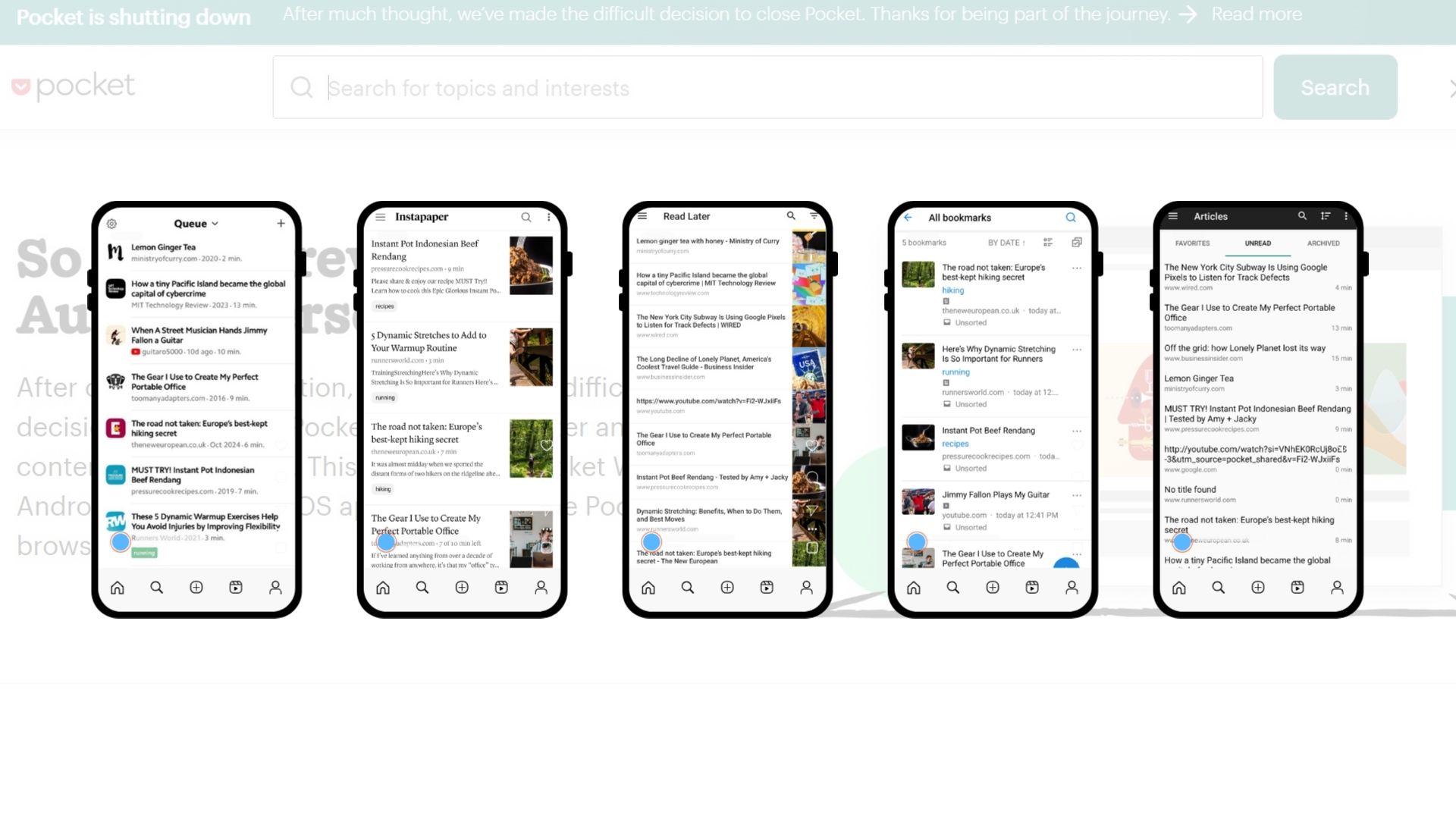
With Pocket Going Away, What’s the Best Bookmarking App Now?

Hot on the heels of Microsoft’s recent decision to shut down Skype, I received another unwelcome email in my inbox last week. Mozilla, creator of the Firefox browser and other useful apps, has decided to kill off not one but two services I use all the time.
The first of those is Fakespot, a site that’s been extremely useful for spotting dodgy Amazon reviews before I hit the purchase button. That’s bad enough in itself, but it’s the demise of another tool that’s the real kick in the teeth.
Pocket, the venerable read-it-later service, is being shut down on 8 July, around six weeks from the date of that email. You’ve got longer to export your saved links: that ability will stick around another three months, until 8 October.
I started using Pocket nearly 15 years ago, long before Mozilla bought it. I’d just begun a new life as a digital nomad, and without widespread availability of cheap prepaid SIM cards (and now eSIMs), I found myself without data service much of the time.
Thanks to its offline mode, Pocket was a godsend. Places to stay, things to do, foods to eat, transport details, and so much more: if I could find it on a web page, I’d save it to Pocket. It only took a couple of taps to bring it back, whether I had phone service at the time or not.
I eventually stopped traveling full-time, but I still kept using Pocket. It became a home for all kinds of new interests instead, and my tags tell the story: #recipes, #hikes, #fitness, #camping, #running.
Mobile data has became much cheaper and easier to find since the early days, of course, but it’s still not available everywhere. On long flights and in remote campsites, the #longreads tag has kept me entertained for many, many hours.
All that to say, I’m genuinely sad that Pocket is going away. Like so many other useful tools, it got sold off to a larger company, floundered along for a few years with no real updates, and got shut down when priorities changed, leaving its users scrambling to find an alternative.
So what are those alternatives? I’ve spent the last few days finding out, checking out almost a dozen different apps that seemed like they might fit the bill.
I didn’t have a long list of requirements for a replacement: it wasn’t like I was a power user of Pocket. I don’t need reading suggestions, automated tagging, or text-to-speech, and I sure as hell don’t need AI giving me a hallucinated summary of my articles.
All I really want is:
- The ability to save links from any browser I use, on desktop and mobile
- An automatic offline mode that works, keeping images and simple text formatting
- An import function for my old Pocket links, and an export function in case this service goes away too
- Some kind of structure like folders or tags, and/or a good search function
- Free for these basic features, even if there’s a premium version as well
Is that too much to ask? Based on how few tools actually met even those basic needs, it kinda seems like it is. Below I’ve focused mainly on the five apps that came closest, although I’ve also explained why the others didn’t make the cut.
Instapaper

Instapaper was started by a single founder around the same time as Pocket, and has had an even more tortured history. Having been owned by the likes of Betaworks and Pinterest over the years, it’s now operated by a small, independent company again.
Does that make it more or less likely to survive long-term? Who knows, but it does mean that some of the features that used to be free are now part of the premium service, presumably because it actually needs to make a profit these days. That’ll set you back $5.99/month or $59.99/year.
There are browser extensions for Chrome, Firefox, and Safari, plus Android, iOS, and macOS apps that let you quickly save and tag links. You can add also links manually from within the site or app.
The interface is clean and sparse, mostly taken up by a vertical list of the links you’ve saved. You can manage and filter by tags and quickly see articles you’ve favorited, and there are dedicated sections for videos, archived links, and any folders you’ve created.
Offline mode for web pages worked pretty well in my testing. Articles appeared almost immediately in the app, with all of the text and most of the images intact. The main image at the top of articles didn’t always appear, though.
Saved video doesn’t work as well, unfortunately: unlike text articles, you can’t access it offline, and Instapaper doesn’t always pick up the name of the video either.
You can edit the title of a saved link on the web (not the app), but it’s an extra hassle, especially if you have a bunch of unnamed video links and don’t remember what each one is without opening it.
In a surprising move that will either nudge people to upgrade or get them to give up on the app entirely, there’s no search function in the free version of Instapaper.
You can still sort and filter by tag or folder, which is fine for smaller collections, but if you’re the kind of person who dumps hundreds of links into the app and doesn’t organize them as you go, finding anything starts getting hard in a hurry.
There’s an import function for several different services, including Pocket. How well it works, however, I can’t currently say: I got a message saying it could take up to a week(!) for the import to run, and currently, four days after starting it, I’m still waiting. Exports, at least, are a quick, single-click affair.
Despite having been around forever, Instapaper does seem to still be in active development: they recently added support for sites that require you to log in, and the ability to save PDFs is currently in beta.
At it’s core, Instapaper does what I need from a tool like this. It’s simple to use and mostly works as it should, without trying to cram hundreds of extra features into what should be a straightforward service. It’s just a shame you have to pay for search.
Pros
Cons
Raindrop

If Instapaper feels sparse and simple, my first impression of Raindrop was that it was anything but. After using it for a while, though, I realized that most of the core features are the same: it’s just the interface that’s busier.
There’s excellent platform support, with extensions available for pretty much any browser you’re likely to be using, plus Windows, Mac, Linux, iOS, and Android apps. Importing from Pocket was fast and accurate, and creating an export file only took a couple of minutes.
You can sort by date, title, and domain name, and view in a few different layouts. A nice touch is the ability to choose exactly what appears in each view: if you don’t ever want to see the thumbnail or save date, for instance, you can disable them.
Folders (called Collections here) and tags are both available, and you can create them either as you save a link or afterward. Like Instapaper, though, there’s no search available in the free version. Premium costs $4.19/month, or $40.99/year.
One of the biggest points of difference to other bookmarking tools is that you can save any file type you like into it. It doesn’t even need to be available at a public URL: you can upload it directly from your phone or computer.
I really like this feature. Being able to save a boarding pass that I’ve downloaded from my email, photos a friend sent me on WhatsApp, and a spreadsheet of my travel plans, then stick them in my Vietnam 2025 folder alongside all the other links for my trip, is genuinely useful.
As positive as I am about Raindrop, though, there’s one massive problem with it: the app has no offline mode at all. It’s so dependent on a server connection that you can’t even see your list of articles if you don’t have data, never mind read them.
There are requests for this feature going back over eight years, so I guess it’s fair to assume it’s not a big priority for the developer. That’s a real shame, as Raindrop would otherwise be an easy pick as a direct Pocket replacement.
Sure, you could use IFTTT to sync up Raindrop with a service like Instapaper that does have offline support, but at that point you may as well just solely use Instapaper and avoid the hassle.
If you’re connected pretty much all the time and don’t care about offline mode, this may not be a deal-breaker. If so, you should definitely take a serious look at Raindrop: it may well fit all your needs. It just doesn’t quite fit mine.
Pros
Cons
PaperSpan

Ever feel like the latest apps and services are too slick and packed with features? If so, Paperspan is the tool for you: it looks and feels like it hasn’t been updated in the last decade.
I’m generally a fan of simplicity, but wow, Paperspan takes it to the next level. There’s a basic app (iOS and Android), an even more basic website, and a couple of minimalist browser extensions and bookmarklets for saving links.
Given its simplicity, I was a bit surprised that its main feature didn’t work reliably. While some of the links I saved showed up fine in the app, others were missing thumbnails, titles, or text, or had broken images randomly strewn throughout.
The app supports offline mode, and it works at a basic level, at least if the article itself has been downloaded properly. I did sometimes took a while for the automatic downloading to work for a new link, though: if that happens to you, you can also manually download a saved link.
There’s no tagging available, but folders work the way you’d expect them to. There’s a full-text search, but like everything else I’ve talked about here, it’s only in the premium version. You’ll pay a bargain-basement $8.99/year to enable it, along with other features like Send-to-Kindle and text-to-speech.
You can supposedly import from Pocket or Instapaper (nothing else), but whenever I tried, I just got a message telling me there’d been a processing error. Exports are in the form of an HTML file that may or may not be able to be read by other services, but I guess you can always just open the file and click the links manually if you have to.
Paperspan is a simple tool that doesn’t have any tracking or ads, so in theory it’s a good option for those worried about their privacy or who just need a basic offline bookmarking service.
If it worked more reliably, I could recommend it at least on that basis, but based on my experience I’d really just suggest looking elsewhere. The app feels abandoned, and given that it was last updated three years ago, I suspect there’s a good reason for that.
Pros
Cons
Wallabag

Wallabag is an interesting proposition. It’s an open-source project that’s strongly focused on data privacy and protection, with nothing hosted on US-based servers and detailed instructions for anyone who’d prefer to host it themselves.
Self-hosting is also the only way to get ongoing access to Wallabag for free: if you want to leave the tech side of things to someone else, it costs money after the initial 14-day trial. Not a lot of money, mind you, at 4€ for three months or 11€ a year.
The service is clearly aimed at advanced users who care more about functionality than aesthetics: it has easily the worst-looking interface on this list, both the website and (especially) the app.
As well as several browser extensions, there are apps for iOS, Android, a couple of non-Kindle e-readers, and unsurprisingly for an open-source project, Linux.
Tags are well supported: not only can you create new tags and assign existing ones when you save a link, but you can also set up complex auto-tagging rules based on anything from article length and content to the domain and language if you’re so inclined.
A bit like Paperspan, though, I had problems saving certain links that were fine in other services, with no real indication as to why. Re-fetching everything didn’t help, and troubleshooting advice pointed me towards a testing service that said everything was working, and told me to log an issue on Github otherwise.
If it had been a one-off, I might have done that, but two failures in my first half-dozen saves pointed towards a more systemic problem. Had I been self-hosting, I could create custom configurations for problem sites, but as it was I out of options.
Offline mode works well in the app, at least when the link itself saved properly. Depending on how you configure it, the pages look closer to the underlying webpage than in most of the other services, and it’s one of the few tools that reliably pulls in the featured image at the top of the article when it exists.
Something I haven’t seen elsewhere is the ability to download your saved links in a wide variety of formats, from PDF to CSV. More than a simple export of the links and tags, these downloads have all of the content included as well. I couldn’t get it to work in the app, but had no issue on the website.
There’s also a wide range of importing options, which reads as much like a technology graveyard as anything else. Omnivore, Delicious, Pocket, and more, there’s no shortage of dead read-it-later services in there.
There was a warning that with an influx of new users, the import might take a while, and indeed it did. Six hours, in fact, but it got there eventually.
Full-text search is built in, and works well: it reliably found words that were in the title or content of my articles, with no false positives that I spotted.
I really wanted to like Wallabag: I’m probably closer to the target audience than most, and would have been happy to self-host it when my trial period ran out.
In some ways, I do think it’s pretty good: it’s just that the combination of clunky interfaces and not entirely-reliable link saving makes it hard to recommend to most people who just want something that looks decent and works without thinking about it.
Wallabag is not that service.
Pros
Cons
Matter

You probably couldn’t find two apps with the same basic purpose that look more different to each other than Wallabag and Matter.
To call the latter beautiful is perhaps a stretch, but it’s certainly slick and attractive in a way that the former is very much not. That’s probably helped by it being an iOS-only app, so if you’re an Android user, feel free to scroll away now.
You’ve got more options on desktop, at least: there are browser extensions for Chrome, Safari, and Firefox. As with all the other services, you don’t need to use any of them if you don’t want to: you can save links directly from the Matter site as well.
The website is usable enough for basic saving, reading, and managing links, but most of the other functionality is only inside the app. That includes imports: rather than uploading a file like everyone else does, the app connects to Pocket and pulls in your saved links directly from there.
One thing that isn’t different, however, is that it takes a while. The suggested timeframe was “several hours”, and it took about four. Exporting, at least, happened immediately, with a zip file full of CSV and HTML files arriving in my inbox.
Saving links and viewing them offline both worked pretty much flawlessly, with none of the weird glitches I’ve talked about earlier. The featured image didn’t seem to make it in, but others did, and all of the text looked fine.
Tags work like you’d expect, as does free-text searching, even offline. The latter isn’t part of the free version, though, and the premium tier is stupidly priced at $14.99/month or $79.99/year.
That version has other features that may appeal to people who aren’t me, like following specific writers, syncing up with your newsletters and RSS feeds, and text-to-speech. Even so, it’s simply too much money for a service like this.
Matter is an attractive app that works well, without the unexplained problems that plague much of the competition. If your mobile devices are exclusively made by Apple and you think the free version of Matter will fit your needs, it’s worth installing it to find out.
If either of those things aren’t the case, however, you’ll need to look elsewhere.
Pros
Cons
Other Apps I Considered
I saw Readeck recommended in a few places, and when I first started playing with the website, it seemed mildly promising. That was until I realised that there were no mobile apps for it, and no offline mode on desktop either. Next.
Brace.to was another service that popped up in my research, and as it turned out, another service that didn’t have an offline mode. That wasn’t enough to put me off by itself, but when saving links didn’t always pull in the title or content properly and I realized that editing said title was a paid feature(!), I quickly hit the uninstall button.
Crate.co easily wins the award for most annoying service on this list .The interface was extremely busy, and the endless AI recommendations were overwhelming and entirely unhelpful. There’s no offline mode either.
Readwise Reader looked like a solid choice for power users, and initially I was quite excited to try it. That excitement quickly wore off when I realized that there’s no free version, and I’d need to stump up $9.99/month to keep using it after a 30-day trial. That’s just too expensive for a read-it-later app, at least for me.
I used Evernote before I even used Pocket, as a combination note-taking and link-saving service. Back then, there was more than enough in the free version for my straightforward needs. Imagine my surprise when I came back to it earlier this week to see that the free version has been absolutely crippled, and paid versions start at a hilarious $17.99/month. Yeah, I’m good, thanks.
Get regular updates from the world of travel tech and remote work
News, reviews, recommendations and more, from here and around the web
Conclusion
My biggest takeaway from this entire exercise was that bookmarking services like these really aren’t very popular any more. Many of the major tools from even a few years ago have been shut down or abandoned, with nothing new to replace them.
I understand why, to some degree: for a long time my read-it-later list in Pocket was more like read-it-never, with an ever-growing pile of articles that I’d never get to. Saving was easy, reading was much harder. I know I’m not the only one in that boat.
Still, once I changed the way I used the service, making it much more targeted and aggressively cleaning out things I hadn’t looked it, it became helpful to me again. I considered not replacing it with anything when it shuts down in a few weeks, but on reflection, I still get enough value to make it worth the effort to switch.
With that in mind, I’ll be moving to Instapaper, assuming my import ever finishes. I don’t love it: the lack of search in the free version is a step backwards from Pocket, and I suspect that eventually it’ll annoy me enough to make me pay for premium. Which, I guess, is the point.
It’s a huge shame that Raindrop doesn’t have an offline mode: if that ever changes, I’ll switch across in a heartbeat. The ability to save and tag anything, not just links, makes it a much more useful tool for the way I’d like to use it.
My main phone is an Android, which rules out Matter for me. If I had an iPhone, I’d certainly consider it, at least until I decided I needed a search function and the exorbitant cost made me delete the app in a fit of rage.
Paperspan seems abandoned, Wallabag is glitchy and overly complex for most people, and everything else I looked at is either too expensive, lacks key features, doesn’t work properly, or is jammed full of AI crap that I neither want nor need.
It’s a sad state of affairs, really.
Have you come across something that you think would fit my needs better than Instapaper? I’d love to hear about it in the comments if so!
All images via author






Good roundup! I have been a longtime Pocket user, so this has disrupted my workflow.
I tried out Raindrop first. Apparently, I signed up years ago, as I already had a login. That’s never a good sign. I read that there is no offline mode, but I figured that surely there is by now. I went to read something offline, and it doesn’t even show a cache. I uninstalled the app immediately. This is the same problem with Notion notetaking app. There seems to be a cult around Notion, but it is completely useless if I can’t use it offline. Notion cultists say, “Just keep a page open that you want to use offline”. Dumb workaround!
Instapaper seems to be the most similar to Pocket. It will take me a few hundred saves to get used to the bookmarking system, but it should do. I don’t like the Times New Roman font (so many aggressive pointy bits). I get that they are trying to be an online newspaper, but they should get with the times and use mobile-friendly fonts.
Yeah I briefly considered Notion as well, partially because of all the cult-like enthusiasm around it, but it really just didn’t seem to do what I needed. As you say, if the answer to not having an offline mode is “just keep the page open” (as if you’re going to know in advance everything you might ever need to access) rather than “yes that’s a missing feature that should be included”, there’s a problem already.
And thank you for pointing out Instapaper’s choice of font! I was finding it unenjoyable to read longer articles on there, and couldn’t really articulate why. Times New Roman is the reason!
Thanks for making this list!
I’ve been using Instapaper since the announcement and it seems OK.
My main use for Pocket was for saving articles then having them automatically sent to my Kindle so I could read them there, as like you, I rarely actually read them in Pocket.
Instapaper has this feature, so it’s good enough for me so far.
I still use RSS (via Feedly) and that plus saving pages for reading later (via Pocket etc) feels pretty old skool and not how most people use the Web anymore!
Yep, I’m exactly the same — RSS via Feedly and Pocket for reading later — and it definitely does feel like an old-school thing that people don’t really do these days.
I’m not (quite) so set in my ways that I wouldn’t switch to a different approach, but I haven’t yet found a better way to follow all the sites and authors I care about without algorithms getting in the way, nor to maintain a curated list of things I either want to keep longer-term (like recipes, training plans, travel info) or don’t have the time to read/watch right now.
I’m on the same quest, with similar needs to yours, and, apart from the fact there’s no import feature for pocket, I don’t hate InoReader. It has flaws (eg no saving to SD card on the android app), and it doesn’t default to making the links available offline (you need to set up the offline mode on a folder by folder basis) but it’s the best of the bunch (and the free version has all I need)
Thanks Sophie, I’ll check it out!
Maybe I’m missing an alternative way of doing it, but it looks like offline reading is a Pro-only feature? That’s what the features table on the site suggests, and seems to be true in the app: I can’t change offline settings and there’s a message about upgrading in the options screen, and my saved articles don’t show up in the app when I’m offline.
If that’s the case then it’s probably a non-starter for me, unfortunately.
I went with the high price for Matter a while ago, and, honestly, I’ve found it valuable, mainly for the text-to-speech function, which works well & helps me with auditory processing & information retention when I need it.
A con for me is how they have the archive system set up. It’s easy enough to add tags, but then navigating to the archive is a bit of a pain.
Another one that’s really good for text-to-speech for those who need it is Speechify. It’s another pricy one, but, if you have scientific research papers you need to read & want the speech-to-text feature, that’s the one I’ve found that can handle the language.